

By Adrie Visscher, University of Twente, Natasha Dmoshinskaia, University of Twente, and Marta Pellegrini, University of Cagliari
Across the world each year, enormous amounts of money are invested in in-service teacher professional development (TPD) every year. These initiatives are designed to support practicing teachers by further developing their professional knowledge, skills, and/or attitudes.
With such significant resources dedicated to supporting teachers, an important question is: what impact does TPD have on student learning outcomes, and which approaches work best for whom?
The variety of TPD programs
The idea behind TPD for benefiting students is straightforward: through participation in TPD, teachers develop professional competences, including knowledge, skills, and attitudes that they apply in their classrooms, creating learning experiences that support student achievement.
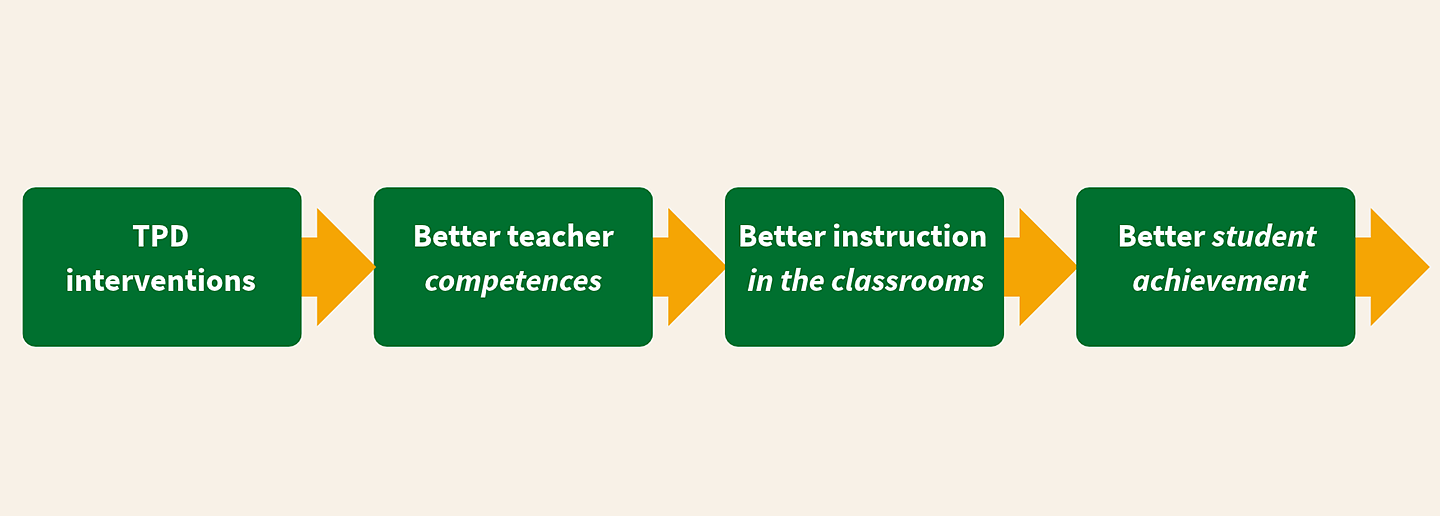
TPD programs differ in what they focus on. Some have the primary goal of expanding teachers’ subject knowledge, or to improve their pedagogical content knowledge (PCK), while others seek to expand teachers’ skills in class management, differentiation, and student engagement. Other programs support teachers in adopting comprehensive approaches, such as school-wide approaches (e.g., Success for All) or broad teaching strategies (e.g., dialogic teaching, formative evaluation) that enhance classroom learning across different subjects. TPD often takes place alongside the introduction of a new curriculum or the implementation of a (digital) new tool, helping teachers to integrate these into their practice.
Explore more: Findings from our systematic review of TPD programs show that the number of high-quality studies is increasing, most of them evaluating PCK programs or TPD for curricula.
Which TPD types work better, and when?
To better understand the effectiveness of TPD, our research team from the University of Twente (the Netherlands) and the University of Cagliari (Italy) conducted a meta-analysis of 128 high-quality studies spanning six countries. We examined whether TPD improves student achievement and which types of programs and characteristics are linked to greater improvements.
Overall, the findings showed a medium positive effect of TPD programs on student achievement; findings suggest there is a 77% chance these programs, on average, will improve outcomes for students in the future (assuming students and schools are similar to those in this review; g = 0.09, 95 % CI [0.07, 0.11]). But TPD programs vary widely in their goals, duration, and the learning-theory principles they include, such as coaching or other forms of teacher support. These differences, along with the context in which TPD takes place, can strongly influence its impact.
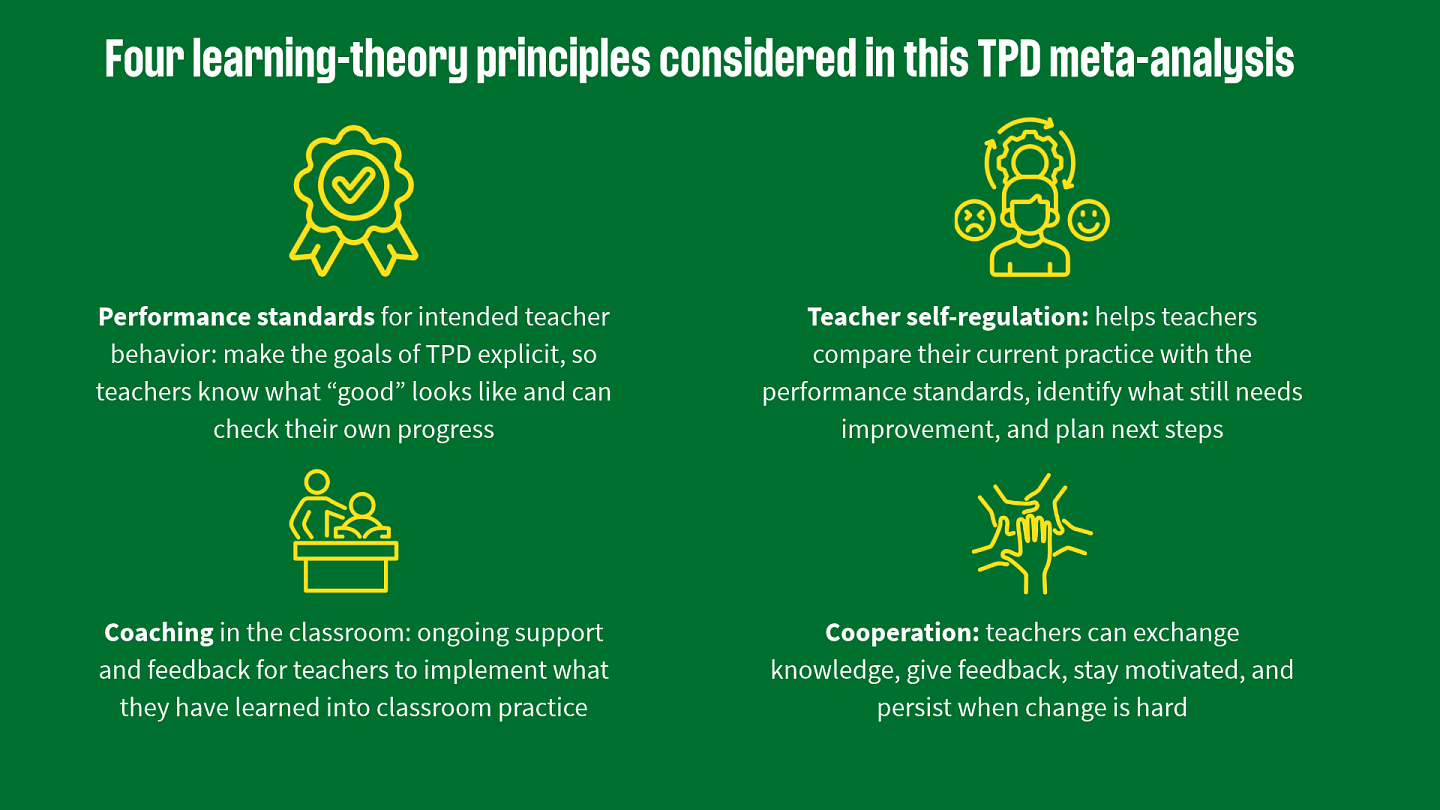
Our meta-analysis found a large variation in effects on student performance, meaning that there are no guarantees of improved student learning as a result of TPD. Instead, some programs can be beneficial for students, while others may have little effect or even negative consequences for student achievement.
An important finding from our research is that how TPD is designed matters. Our findings show a clear pattern: the more learning-theory principles built into a TPD program, the greater the improvements in student outcomes. In our included studies, teacher self-regulation and coaching were the most common elements, followed by performance standards and teacher cooperation.
Our findings also show that no particular TPD goal stood out as the most effective. Instead, TPD programs targeting PCK, comprehensive approaches, and curricula produced similar effects on student outcomes.
What we do not know yet
There are still many questions to answer. We know that combining multiple learning principles in a TPD program is likely to improve student learning, but we do not yet know which combinations work best. We need primary studies evaluating TPD programs with several combinations of principles to enhance our knowledge on that.
Another open question is whether TPD works differently in different contexts. Our review found no clear differences between interventions carried out in contexts with lower or higher socio-economic status. Two other recent reviews found no evidence that TPD is more or less effective depending on teachers’ level of experience. Understanding which TPD types work best where and for whom remains an important area to explore.
Our recommendations:
- If you are a TPD designer:
- When designing or revising a TPD program, make as detailed an analysis as possible of what the TPD program intended teacher competence looks like, formulate the competence in terms of standards and share them with the teachers from the start.
- Involve teachers actively in the TPD program and make sure they will be supported long enough through classroom coaching so they can apply what they learn in the classroom effectively.
- Let teachers collaborate in TPD programs, so they can support each other and make the TPD impact bigger.
- If you are a principal or a teacher:
- When choosing a TPD program, check what the intended TPD goal is, and why teachers should work on that goal. Here are some key questions to consider:
- Is there strong evidence that the TPD improves teaching quality and student learning, or is the program just another exciting idea?
- How and how much are teachers supported in the program in changing their classroom practice?
- Is there a balance between the complexity of what has to be learned and the amount of support teachers will receive?
- During the implementation of a TPD program, do formative assessments to measure impact and redirect where necessary.
- Emphasize teacher cooperation, instead of individual professional development trajectories next to each other, and give teachers the appropriate time and resources to work on TPD.
- When choosing a TPD program, check what the intended TPD goal is, and why teachers should work on that goal. Here are some key questions to consider:
Additional resources:
- Frerejean, J., van Geel, M., Keuning, T. , Dolmans, D., van Merrienboer, J. & A.J. Visscher (2021). Ten steps to 4C/ID: training differentiation skills in a professional development program for teachers. Instructional Science, 49, 395–418 (2021). https://doi.org/10.1007/s11251-021-09540-x
- Effective Professional Development by the Education Endowment Foundation: https://educationendowmentfoundation.org.uk/education-evidence/guidance-reports/effective-professional-development?ref=alexquigley.co.uk
Want more from the HEDCO Institute: Sign up for our emails!
HEDCO Institute article 36- November 18, 2026