

By Stacy Bonner,PhD, Director of Special Services for the Pasco School District in Pasco, Washington
In recent years, educators and policymakers have placed growing attention on student well-being as schools respond to challenges ranging from chronic absenteeism and mental health concerns to declining student engagement. School belonging is often pointed out as a powerful factor in addressing these challenges, but is often centered around students, not the adults that shape student experiences.
As part of our ongoing series examining school belonging, this article comes from Stacy Bonner, Director of Special Services for the Pasco School District in Pasco, Washington. Looking directly at her experiences working in schools, Bonner describes promising approaches for fostering school belonging among teachers and the powerful potential this has for shaping school experiences.
What if we designed schools for adult belonging too?
As I enter my fifth year as a PK–12 leader (18th year working in public education), some of the most important conversations I've had have also been some of the hardest. More than once, a staff member has looked me in the eye and said, "I don't trust leadership." My first instinct was to explain that I was new, that I wasn't the leader who had let them down, or that I wanted to do things differently. But I quickly realized the conversation wasn't about me. It was about their lived experience within the system.
I've come to believe that belonging isn't something leaders create directly.
Leaders create the conditions that allow belonging to emerge.
We have become increasingly skilled at designing schools around student belonging. State departments are even creating policy related to systems that promote belonging. Think MTSS, UDL, Trauma Informed practices. While student experiences and outcomes are at the heart of our work, we rarely ask whether we've designed workplaces where the adults responsible for creating that belonging experience it themselves.
Every interaction a student has during the school day—being greeted in the office, eating lunch, riding the bus, checking out a library book, working with a paraeducator, meeting with a speech-language pathologist—is shaped by an adult. If belonging matters for students, then belonging must matter for every adult who creates those moments.
Belonging doesn’t happen by accident.
Belonging doesn't happen by accident. It emerges from the conditions leaders intentionally create. Research across education and healthcare—two complex, people-centered public systems—suggests that educator wellbeing, commitment, and retention are shaped not only by workload, but by workplace relationships, trust, and organizational climate1. These are not peripheral concerns; they are essential organizational conditions that influence whether people feel safe enough to contribute, learn, and choose to stay.
If belonging is the outcome, what are the leadership behaviors that help create those conditions?
One framework that resonates with my own leadership experience comes from healthcare. The CALM framework—Conversation, Active Listening, Leadership Engagement, and Mechanisms for Feedback—emphasizes intentional leadership practices that build trust over time. Rather than expecting leaders to have all the answers, CALM encourages leaders to be visible, listen without becoming defensive, invite honest feedback, and close the feedback loop by communicating what they learned and what actions will follow. Staff consistently report feeling more supported when these conditions are present.2
What strikes me most about CALM is that none of these practices creates belonging directly. Individually, they're simply leadership behaviors. Collectively, they create the conditions where belonging can emerge.
- Conversation: You matter.
- Active listening: Your experience matters.
- Leadership engagement: Your work matters.
- Closing the feedback loop: Your voice matters because it shapes what we do next.
Belonging is not a leadership strategy. It is the natural outcome of intentionally designed organizational conditions. Belonging is what grows when people consistently experience these conditions.
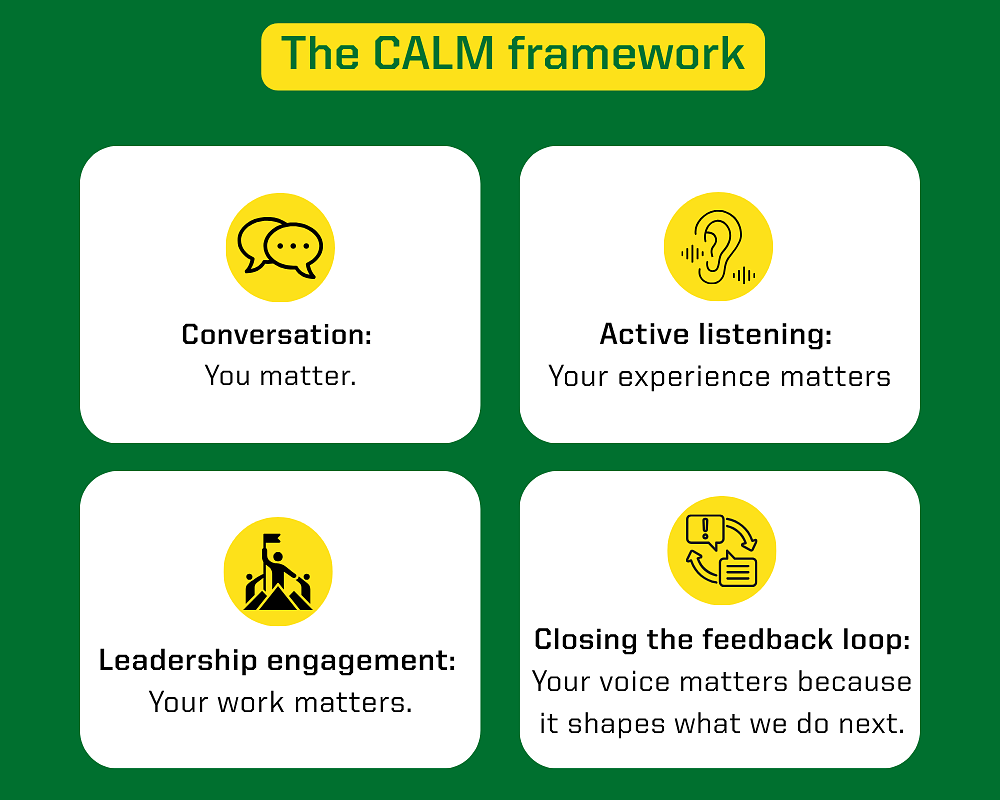
The CALM framework reinforces something I’ve been experiencing as a leader: belonging isn't built through a single initiative or leadership strategy. It emerges when leaders intentionally design the conditions that help people feel seen, heard, valued, and safe enough to contribute. As I reflected on this idea, I realized I already knew a framework built on the same principle—Universal Design for Learning (UDL).3
If UDL asks educators to design for learner variability, human-centered leadership4 asks leaders to intentionally design for human variability. Human-centered leadership is a developing approach to leadership and coaching that prioritizes human flourishing, relationships, and environments where people are set up to do their best work. The Institute of Coaching at McLean Hospital and Harvard Medical School are working to formalize this framework by combining research from psychology, coaching science, organizational behavior, and leadership.
Instead of asking educators to be more resilient, adaptable, or engaged, human-centered leaders ask a different question: How might we intentionally design workplaces that anticipate human variability—including culture, identity, lived experience, disability, and neurodivergence—so every adult has equitable opportunities to contribute, grow, and belong?
Perhaps the most important question for leaders is, "What am I designing every day that either invites people in or unintentionally leaves them out?" Every meeting agenda, feedback conversation, hiring process, professional learning opportunity, and policy communicates who belongs here. Human-centered leadership isn't about creating belonging directly, it's about intentionally designing the conditions where every adult can contribute, grow, and thrive. It is about removing the barriers that prevent belonging from emerging. When adults experience that kind of belonging, they're better equipped to create classrooms where students experience it too.
Human-centered leadership isn't about creating belonging directly, it's about intentionally designing the conditions where every adult can contribute, grow, and thrive.
Students experience belonging because adults experience belonging.
Every school wants students to feel seen, heard, valued, and connected. We know this is important for student school experiences and outcomes that extend far beyond the academic outcomes in school. Those experiences begin long before students enter a classroom. They begin with the adults who welcome them, teach them, feed them, support them, and believe in them.
Human-centered leadership reminds us that creating schools where every student belongs starts by creating workplaces where every adult belongs. Every decision we make as leaders communicates who belongs here. My hope is that we begin designing our organizations with the same intentionality we bring to designing learning—because when adults know they belong, students are far more likely to know they belong too.
Perhaps that's the real work of leadership—not convincing people they belong, but intentionally designing the conditions where they no longer have to wonder if they do.
Want more from the HEDCO Institute: Sign up for our emails!
End note:
- Zhou, S., Slemp, G. R., & Vella-Brodrick, D. A. (2024). Factors associated with teacher wellbeing: A meta-analysis. Educational Psychology Review, 36, Article 63. https://doi.org/10.1007/s10648-024-09886-x
- Iqbal, U., Wilson, N., Taylor, R., Smith, L., & Kohler, F. (2025). Using conversations, listening and leadership to support staff wellness: The CALM framework. International Journal of Environmental Research and Public Health, 22, Article 1558. https://doi.org/10.3390/ijerph22101558
- CAST. (2024). Universal Design for Learning Guidelines version 3.0. https://udlguidelines.cast.org
- Leclerc, L., Kennedy, K., & Campis, S. (2020). Human-centered leadership in health care: An idea that's time has come. Nursing Administration Quarterly, 44(2), 117–126. https://doi.org/10.1097/NAQ.0000000000000409
HEDCO Institute article 30 - August 5, 2026