


By Matthew Linick, NORC Senior Fellow, and Lisa Shimmel, NORC Principal Research Director, explore what knowledge mobilization looks like in practice—and why partnerships make it possible.
In the first installment of this series, Elizabeth Day and Kristen Elmore introduced knowledge mobilization as the intentional process of connecting researchers, practitioners, and policymakers so evidence is more useful, relevant, and responsive to the needs of those who put it into practice. In the second installment, Katherine Philp examined the role of knowledge brokers—the people and organizations that help create those connections across the education ecosystem.
But an important question remains: What does knowledge mobilization actually look like in practice?
Knowledge mobilization is both an outcome and a practice. As an outcome, it means evidence informs policy and practice. As a practice, it is the day-to-day work of building relationships, creating opportunities for shared learning, and making evidence accessible and actionable.
Evidence rarely moves directly from a research report into state policy, district strategy, or classroom practice. Education leaders make decisions in complex environments shaped by local priorities, resources, timelines, and community needs. Even strong research can struggle to gain traction if it does not connect to those realities.
That is why knowledge mobilization must move beyond one-way dissemination and toward partnership.
Beyond the research report
Researchers may hope that evidence use begins when they publish findings and ends when educators or policymakers read them. In reality, meaningful evidence use requires more intention and collaboration.
As earlier posts in this series noted, education decision- makers draw on many sources of information, including research, professional experience, peer recommendations, organizational priorities, and local context. Successful knowledge mobilization recognizes this complexity and creates opportunities for these varied considerations to inform one another.
Mobilizing knowledge is not simply about making research available. It is about creating structures that allow researchers and decision- makers to examine evidence and local context together. These structures create space to ask questions, test ideas, adapt strategies, and learn from implementation.
In short, knowledge mobilization happens through relationships.
The infrastructure behind knowledge mobilization
The previous installment described knowledge brokers as the connective tissue of the education ecosystem. They connect research and practice not only by sharing information, but also by translating evidence, facilitating dialogue, and helping interest-holders make sense of research in ways that fit their contexts.
But knowledge mobilization is not work that one person or organization can do alone. It requires infrastructure: networks, partnerships, and systems that create regular opportunities for collaboration and learning.
Viewed this way, knowledge mobilization is more than a single project or study. It is a sustained approach to organizing how research, policy, and practice interact. Strong partnerships bring together organizations with distinct strengths—such as research, technical assistance, professional learning, implementation support, and systems improvement—to create pathways from evidence to action.
Strong partnerships bring together organizations with distinct strengths—research, technical assistance, professional learning, implementation support, and systems improvement—to create pathways from evidence to action.
(RELs) are an example of a federally funded network that generates and mobilizes research evidence in collaboration with state and local partners as well as other federal technical assistance providers. When these efforts are intentionally aligned, they create a stronger bridge between evidence generation and evidence use.
From a knowledge mobilization perspective, the value of these partnerships lies in sustained opportunities for researchers, practitioners, and policymakers to learn from one another. Research activities can be shaped by practitioners’ priorities, and implementation efforts can be informed by current evidence.
What's are the Regional Educational Laboratories (RELS)?
The nation's 10 Regional Educational Laboratories partner with educators and policymakers nationwide. REL work is change-oriented, supporting meaningful local, regional, or state decisions about education policies, programs, and practices designed to improve learner outcome.
RELs collaborate with state departments of education, school district leaders and classroom educators, and other education stakeholders to address their most pressing problems of education policy and practice. Our work includes high-quality applied research; training, coaching, and technical support to educators and policymakers; and sharing information about "what works" to improve learner outcomes.
Learn more about our work in each REL region below.
What this looks like on the ground
REL Pacific offers examples of how partnerships can help educators and policymakers use evidence in context. One way REL Pacific approaches supporting evidence use is by pairing research products with facilitated discussions and planning activities that help partners interpret findings, consider implications, and identify next steps aligned with their local priorities, systems, and timelines. This approach helps partners move from findings to action by broadening understanding of the evidence, identifying next steps, and supporting continued improvement beyond a single study or report.For example, the College of the Marshall Islands (CMI) partnered with REL Pacific to study its updated English Language Arts placement process, including how different placement measures linked with students’ course outcomes, passing rates, and continued enrollment. To help make the findings easier to share and use, REL Pacific also created an infographic highlighting the study’s main takeaways:
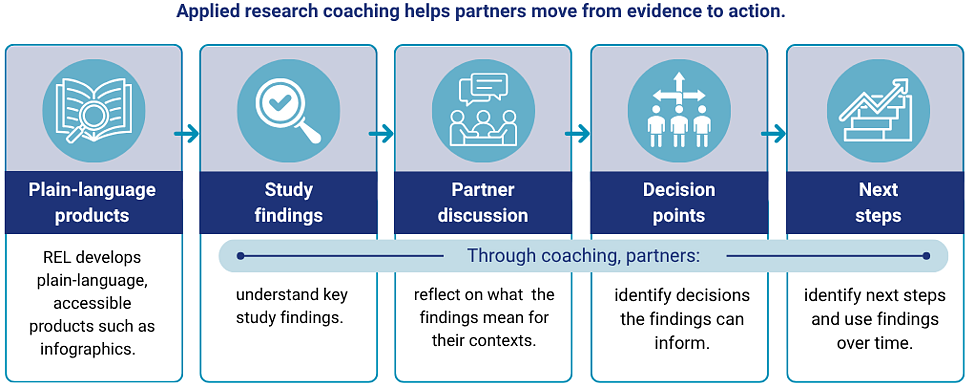
In May 2026, REL Pacific presented the findings in separate conversations with CMI English faculty, CMI senior leaders, and leaders from the Republic of the Marshall Islands Public School System. Those discussions helped CMI consider next steps for strengthening its ELA placement approach. As a result, the college plans to keep refining the process to better support students, explore options for placing more students directly into credit-bearing coursework, and work with the Public School System to build students’ ELA skills before they enter college.
The focus was not simply on delivering knowledge. Researchers contributed evidence and analytical expertise; technical assistance providers helped translate insights into action; and practitioners brought deep knowledge of their schools, communities, and implementation realities. Together, they created a shared learning process that allowed research and practice to inform one another.
Looking ahead
As interest in evidence-informed decision making grows, education systems need more than strong research products. They need relationships, networks, and organizational structures that support ongoing collaboration and shared learning.
Knowledge brokers play an important role in creating those connections. But lasting impact depends on partnerships that make evidence use part of everyday improvement work.
Lasting impact depends on partnerships that make evidence use part of everyday improvement work.
When these elements come together, evidence becomes more than something researchers produce and disseminate. It becomes a resource that educators, researchers, and policymakers can use together to address challenges, improve outcomes, and strengthen opportunities for learners.
Ultimately, knowledge mobilization is about more than just moving research into practice. It is about building the relationships and structures that allow research and practice to continuously inform one another.