

Getting research into the hands of practitioners and policymakers does not happen by accident: it takes resources, a deliberate focus, and a supportive organizational environment, among many other things.
To help simplify the ins and outs of these processes, we asked professionals who specialize in knowledge mobilization to offer their insights and experiences. We’ll present their insights over the next year through an Ask HEDCO series: Knowledge Mobilization 101.
In a prior post, Elizabeth Day and Kristin Elmore described the basics and importance of knowledge mobilization, the process of intentionally connecting researchers, practitioners, and policymakers so that evidence can be more useful and responsive to the needs of those who will put it to use. But, of course, knowledge doesn’t move on its own.
If we want high-quality, rigorous research to impact educational practice and policy, and conversely, if we want problems of practice to truly drive research agendas, it’s clear that improving the flow and exchange of information is needed. When knowledge mobilization results in stronger connections between research and practice, it is due to the people and organizations making it happen: knowledge brokers.
In this post, Katherine Philp, Director of the Education Knowledge Broker Network, unpacks who education knowledge brokers are and the essential roles they fill.
Who are knowledge brokers?
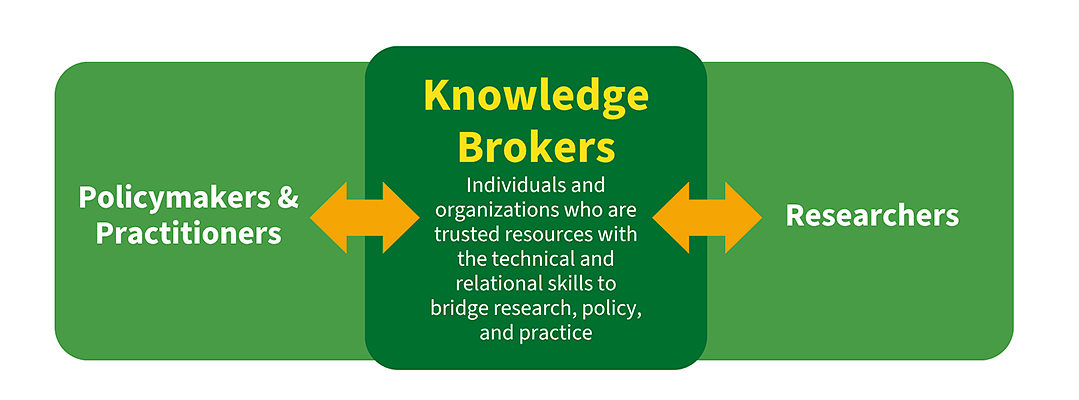
These are individuals and organizations (like the HEDCO Institute, for example) who serve as a bridge between research and practice, mobilizing evidence for impact, and ensuring the research they build upon is relevant, useful, and timely for practitioners and decision makers.
The language of knowledge mobilization continues to evolve, and you might see other similar terms referring to the people doing this work used in academic and popular literature: boundary spanner, intermediary, third space professionals, and so on.
Fundamentally, those working as knowledge brokers mobilize evidence for impact and ensure that research being produced is relevant, useful, and timely for practitioners and decision makers.
Effective knowledge brokers work across traditional boundaries, often navigating the conflicting priorities and norms of the research and practice worlds. This requires the development of complex skills such as interpreting and communicating research, facilitating relationships and partnership work, and developing a deep understanding of practice contexts. Knowledge brokers have been linked to positive school-level changes in the use of research evidence, improved educator professional learning outcomes, and improved cultures of research use, among other impacts.
What roles do knowledge brokers fill?
In an upcoming report from the Education Knowledge Broker Network (EKBN), we’ll be sharing the results of a recent survey that showcases the diversity of roles and titles held by knowledge brokers across the education sector. Preliminary analysis finds knowledge brokers operating in areas such as K-12, higher ed, early childhood ed, and community education settings; spanning systems levels from classrooms to federal policy; and engaging in multiple job functions that include teaching, research, evaluation, coaching, communications, and more.
While knowledge brokers occupy a vast array of roles and responsibilities, they nevertheless share important commonalities. Colleagues at the Center for Research Use in Education at the University of Delaware have identified core competencies for effective knowledge brokering. These include having sufficient expertise to evaluate research in light of specific practice or policy context, strong communication skills, a commitment to equity, and the ability to build strong relationships across diverse interest-holders.
Thus, they often serve as trusted resources with the technical and relational skills needed to critically assess a body of evidence, support appropriate application of evidence to practice, and inform research agendas by elevating lived experience and context expertise.
The Connective Tissue of Knowledge Mobilization
Access to evidence is a widely recognized barrier to use, yet we also know that access alone is not enough to promote strong evidence use in practice. Knowledge doesn’t move on its own: knowledge brokers are the connective tissue that creates opportunities for knowledge exchange across otherwise disconnected components of the education ecosystem.
Despite their documented impact, knowledge brokers remain education’s most underutilized asset. In fact, many knowledge brokers don’t yet identify as such! What if we could elevate the role of knowledge brokers who are already hard at work across the education ecosystem and connect them in ways that promote improved knowledge exchange and ultimately, improved educational impacts?
EKBN is addressing this gap, transforming an invisible workforce into a professional field by creating formal learning opportunities and community, and collaborating with partners like HEDCO Institute to raise awareness of these roles. In short, we are building the essential infrastructure necessary for a more responsive, evidence-informed education system and ensuring that high-quality research achieves its intended purpose: measurably improving educational outcomes.
Want more from the HEDCO Institute: Sign up for our emails!
HEDCO Institute article 32- September 16, 2026