

By Lillian Durán, Professor, Research Institute for Implementation Science in Education (RIISE) Scholar, Special Education, University of Oregon
The screening of multilingual students for reading problems often sparks fierce debates, since many questions arise when conducting these screenings. Questions such as, What are the best approaches to reduce bias in testing? How can we account for varying levels of English proficiency? How do we select screening tools that can be used with confidence with this population?
About 10% of elementary school students in the U.S. speak a language other than English at home and have emerging English proficiency when they enter school. Currently, 49 states have passed legislation that mandates universal reading screening, meaning that screening solutions need to be in place to accurately and fairly measure the reading abilities of ALL children including those classified as English learners.
Developing a reading screening measure for the diverse students of California
Over the last four years, I have been collaborating with a team of researchers at the University of California San Francisco (UCSF) Dyslexia Center on the development of reading screening measures designed specifically for the diverse student population in California.
In 2021, UCSF was allocated $30 million dollars directly from the state legislature to develop a universal reading screening that would be psychometrically rigorous and available at no cost to all public schools in the state, with the specific mandate to focus on fairness and accuracy in testing multilingual students. I served as one of the lead scientists in the development of the screening battery that has come to be known as “Multitudes.”
Following a systematic multi-year development process involving over 8,000 children in grades K-2 across the state, the Multitudes screening battery, along with a number of follow-up assessments, were created in English and Spanish.
The Multitudes universal reading screening battery is a computer adaptive assessment administered in about 10 minutes by a teacher and is currently employed in more than 1,500 schools statewide in California, serving approximately 220,000 children in grades K-2. Efforts are also currently underway to develop reading screeners in Mandarin and Cantonese.
California has the highest percentage of multilingual children enrolled in elementary public schools, with more than 20% of students classified as English learners with about 100 different languages spoken by children across the state. This context provides an important opportunity to explore large-scale solutions to reading screening with multilingual students.
Beyond reading: the importance of measuring language development more broadly
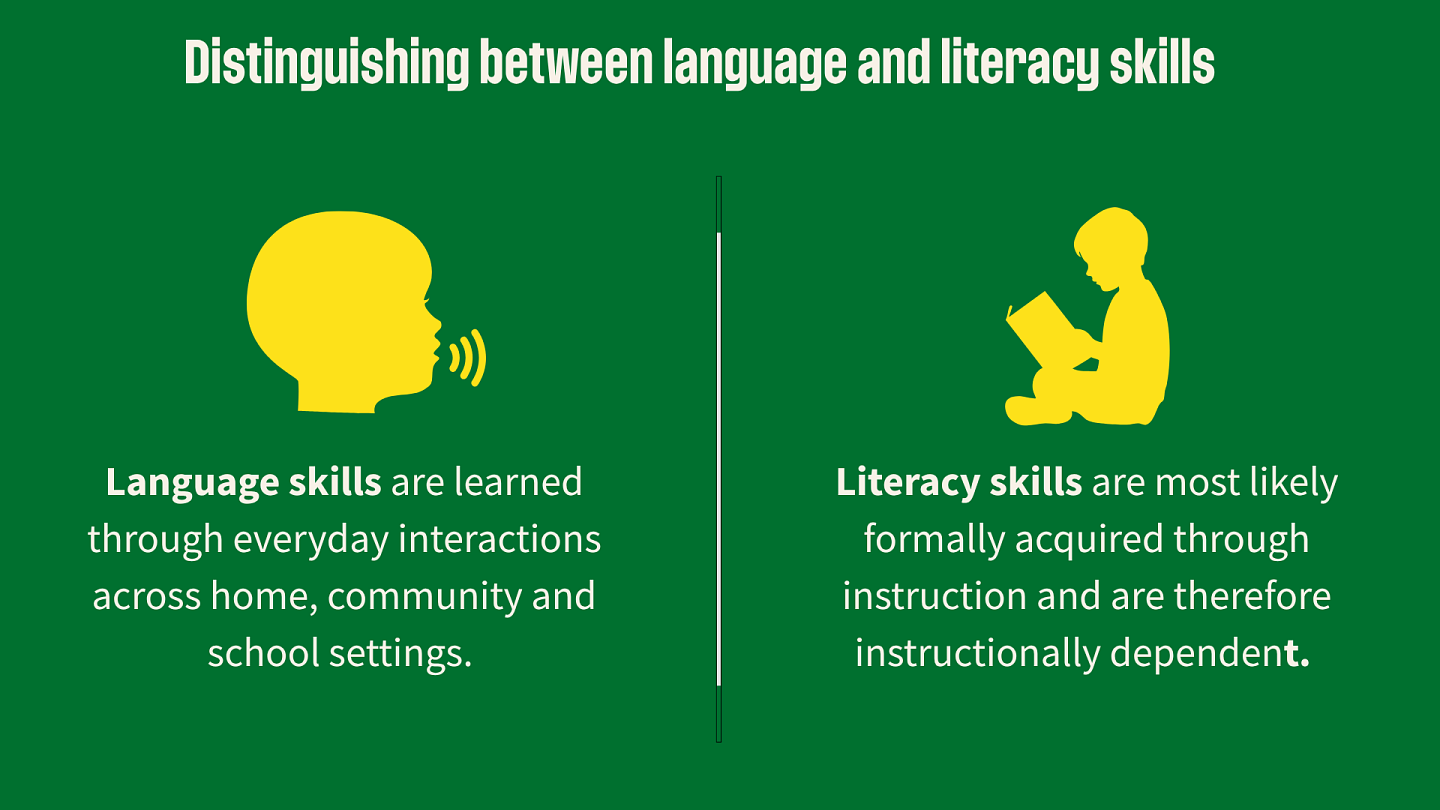
When screening for reading problems, it is important to distinguish between language and literacy skills. Language skills are learned through everyday interactions across home, community ,and school settings. Reading skills are more likely formally acquired through instruction and are therefore instructionally dependent. This means that if a child is not instructed to read in a language, a reading screening in that language is unlikely to yield an accurate estimate of their reading ability, even if they are more proficient in that language.
This is why with the Multitudes approach not only do we have reading screening assessments, but we have also developed five language measures that can be administered following screening to learn more about a student’s language development. Those measures include listening comprehension, sentence repetition, narrative story retell, expressive vocabulary, and semantic mapping.
Multitudes is particularly innovative in approaches to presenting and measuring narrative story retell and expressive vocabulary.
- Narrative story retell: Our research team designed four short wordless videos depicting common events. The child watches one of the videos and is asked to describe what happened. Scoring protocols are translated into many languages; if a teacher can find one person who speaks that child’s language, they can easily administer and score this assessment, providing a window into that child’s language ability.
- Expressive vocabulary: Children can respond in English or Spanish and use their total language repertoire to provide a more accurate account of their vocabulary. This measure recognizes that multilingual children will draw on all of their linguistic resources when responding to test items and there are ways that we can honor their knowledge in both languages when we design assessments.
Language is the foundation of literacy and by employing this innovative approach to screening we are providing teachers with tools that not only specifically screen for reading problems, but that can also provide information about a student’s language development in English, Spanish and in other languages we are currently working on, including Arabic, Cantonese. Korean, Mandarin, Tagalog, and Vietnamese.
Reading screening is about more than just a child’s ability to decode words. There are many component skills that are interwoven and that interact to support fluid and accurate reading and reading comprehension.
The Multitudes approach emphasizes the critical role of language development in reading. Rather than only providing solutions in English, we have taken on the challenge of designing measures in other languages, and provided scoring mechanisms that make it possible for teachers with limited resources to learn more about the child’s language ability in their native language. This will provide the teacher with more information about that child from a strength-based perspective and provide an opportunity for the teacher to learn more about the skills they are bringing to the task of learning to read in English.
There is still a lot of work to be done to meet the demands both in California and nationally as the multilingual population continues to grow, but these innovations in the largest state in the U.S, are serving to demystify the screening of multilingual students by providing real life solutions that are scalable.
Solutions are possible when researchers are dedicated to centering the assessment needs of the multilingual population and when policymakers invest in the populations they are elected to serve.
Want more from the HEDCO Institute: Sign up for our emails!
HEDCO Institute article 35- October 21, 2026