

By Sean Grant, DPhil, Research Professor at the HEDCO Institute for Evidence-Based Educational Practice, University of Oregon
A global effort is underway to make evidence syntheses continuously current — with help from AI. Here’s what that means for education.
Imagine your school district is deciding whether to adopt a program to prevent student anxiety. You want to know what the research says. Not just one study, but all of them, put together in one place with the findings summarized. That is the job of a systematic review. A research team searches for every relevant study, screens each one against clear criteria, extracts the results, and combines them into a synthesis of all the evidence. Done well, a systematic review is the most trustworthy summary of what research can tell us about a question.
Why do research summaries go out of date?
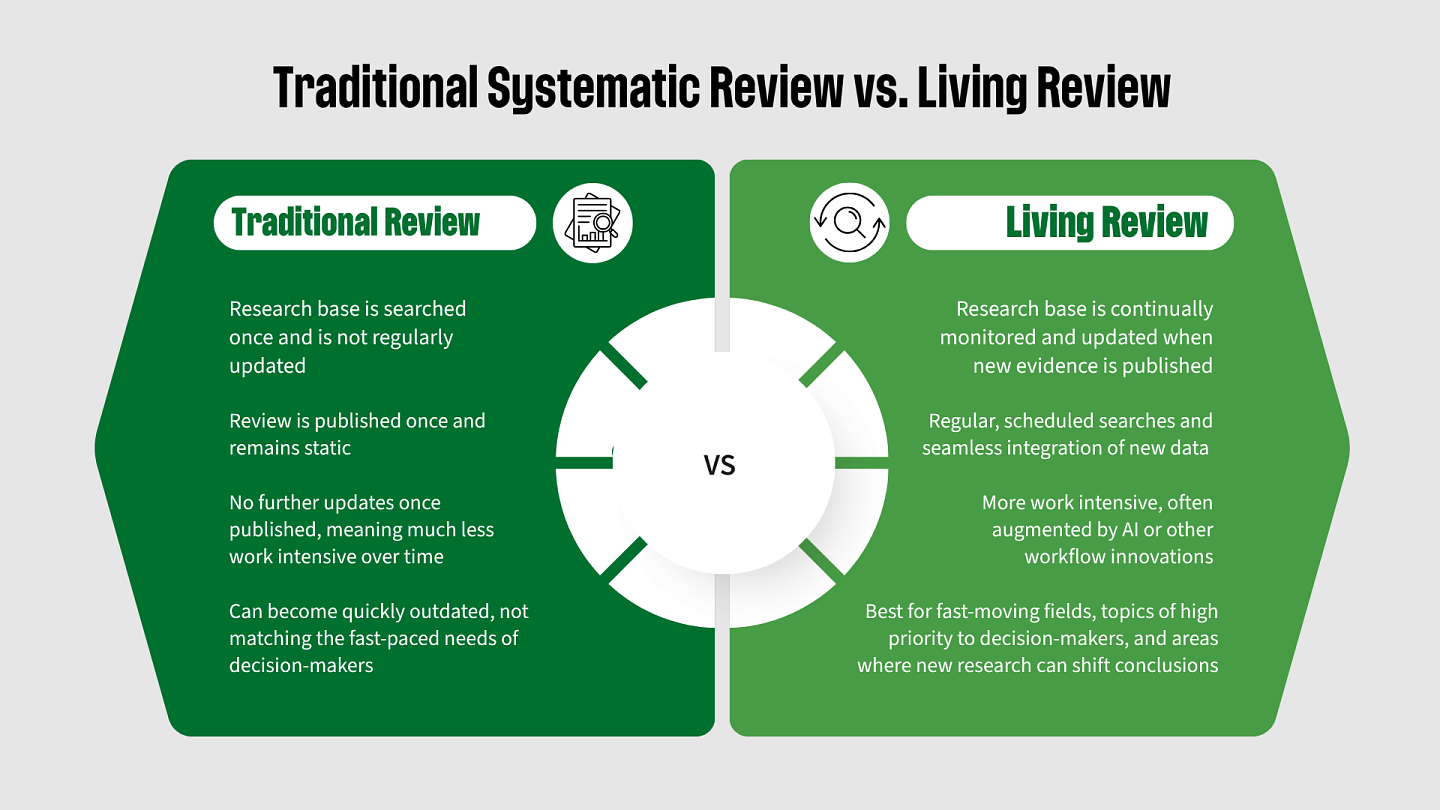
Systematic reviews have a timeliness problem. A typical review takes a team a year or more to complete. Meanwhile, new studies keep being published. By the time a review appears, it may already be missing relevant (newer) evidence. A few years later, it can be badly out of date. A superintendent or state agency reading that review has no easy way to know what has changed since the authors stopped searching, and in fast-moving areas of research, the difference between the evidence that exists and the evidence that has been summarized matters.
What is a “living” systematic review?
A living systematic review is continually updated, with newly-identified evidence added to the review as soon as it becomes available. On a regular schedule, the team searches for new studies, adds the ones that qualify, and updates the results. That way, the findings presented reflect the evidence as of the most recent update. The living approach became more mainstream during the COVID-19 pandemic, given the explosion of new research and importance of up-to-date treatment guidance.
Where does AI come in?
The pandemic demonstrated the value of living reviews, but it also demonstrated their bottleneck: continuous updating is expensive when every step requires manual effort. This is where artificial intelligence comes in. At present, AI can already help with evidence surveillance, accelerating screening and identification of new eligible studies. And it shows promise with extracting information and results from studies. There is hope it can support assessing study quality, updating meta-analyses (statistical summaries of results across studies), and creating credible evidence summaries. Yet while AI reduces the repetitive workload, humans remain responsible for judgment. Deciding whether a study truly qualifies, how trustworthy its methods are, and what the results mean for practice remains the work of trained reviewers.
What is happening globally with AI-enabled synthesis?
The Evidence Synthesis Infrastructure Collaborative, or ESIC, is a global community that aims to transform how we produce and use evidence synthesis to improve lives. Its members include 45 United Nations entities working through the Global SDG Synthesis Coalition, the largest producers of systematic reviews in the world (Cochrane, Campbell, and JBI), networks of evidence advisors, and more than 35 funders. In September 2025, at the United Nations Sustainable Development Goals forum, ESIC funders announced that mobilized commitments had reached $126 million in under a year.
As it says in its name, its key focus is infrastucture. Instead of every review team building its own searches, tools, and databases separately – as is traditionally done in academia – ESIC is funding shared systems that any team can use. Its first investments include an open data system for sharing study records, a public inventory of AI tools for evidence synthesis, and sector-specific hubs that will enable the production of living evidence syntheses on major policy questions. ESIC is also demand-driven: it centers on the questions decision-makers need answered, not just the studies researchers have produced. Each hub will maintain a question bank informed by users of evidence and will track "windows of opportunity," the moments when a pending decision makes evidence especially useful.
Why should the education community care?
Two reasons. First, education is one of the first sector-specific hubs targeted by ESIC. UK Research and Innovation is funding evidence synthesis infrastructure for education, and the Jacobs Foundation has aligned its education investments with ESIC. Second, most early living evidence work happened in health, and the benefits seen there have the potential to improve synthesis research in education. School boards, state agencies, and district leaders face questions where the research base changes every year. For example, student mental health, literacy instruction, school schedules, and technology use are ever-evolving and evergreen topics for educational decision-makers. As this shared global infrastructure develops, it should become faster and cheaper for education-focused teams everywhere, including here in the United States, to keep their reviews continuously current. And because the infrastructure is demand-driven, those reviews should be organized around the questions educators are actually asking, ready when a decision has to be made. Decision-makers would then get answers that reflect this year's evidence rather than last decade's.
What is HEDCO doing?
At the HEDCO Institute, we are conducting living systematic reviews on school-based prevention of depression, anxiety, and suicide, along with interactive dashboards that let educators explore the findings for themselves. We use AI tools to help monitor and screen new research, and we evaluate how well those tools perform before trusting them. We are also engaging with the international community building this shared infrastructure, so that education decision-makers in the United States benefit from it. If your school, district, or agency is interested to learn more, please reach out!
Want more from the HEDCO Institute: Sign up for our emails!
HEDCO Institute article 30- August 19, 2026