
An example with Romani students in Portugal
By Tiago Lobo-Dos-Santos, President and Co-Founder of the Yazele-Calon Institute, Doctoral Candidate in Family Sciences at the University of Kentucky
With approximately 6 million people living in the European Union (EU), the Roma are the largest European ethnic minority.Comprised of various ethnic subgroups, they have historically been subjected to enslavement, genocide, and exclusion. The legacy of such heavy history endures in the present.
Educational disparities are particularly striking in Portugal. Based on a 2024 survey involving data on 1,163 Portuguese Romani respondents (Ciganos Calons), only 46% of Portuguese Romani children attend preschool (vs. 94% of Portuguese ethnic majority) and only 8% of Romani youth aged 20-24 have graduated from high school (vs. 89% of Portuguese ethnic majority).
The Yazele-Calon Institute was founded precisely with the intention of using high quality evidence as a tool to curtail these huge gaps between Romani and Ethnic Majority youth, with a specific focus on educational outcomes. The Institute’s theory of change starts with collaborative longitudinal research design and planning, followed by performing the research in-context, and delivering the results back to the community, putting data at the service of interest-holders. Hence, longitudinal studies are co-designed with the community by generating and receiving input from diverse interest-holders (e.g. teachers). The research team engages and promotes dialogue about key issues faced by children, youth, and families throughout their primary education. These studies seek to identify what is important to investigate in terms of student developmental outcomes and what factors might positively or negatively change these priority developmental outcomes.
This case of co-designed research can serve as an inspiration to researchers in the US, looking to improve similar outcomes for minority and underserved populations in their own work. This is because educators can bring fruitful contributions to educational science, based on their experiential knowledge, which can help to further inform and improve both research and educational practice.
Educators may also benefit from engaging in processes of research to their own practices. For instance, by thinking critically about what may explain the behaviors, outcomes and challenges of ethnic minority students, as well as by being exposed to how the explanations of different interest-holders – such as ethnic minority parents – might promote positive changes in teachers’ educational practices and/or school leadership decisions, even before the outcomes of the substantive longitudinal study come into play.
The Yazele-Calon Institute’s Approach to Co-Design
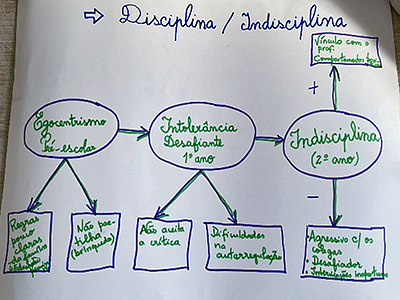
We started by engaging teachers in co-designing a longitudinal study in a school district (Agrupamento de Escolas) with a large representation of Portuguese Romani children (Ciganos Calons). Teachers were encouraged to perform the role of researchers, based on their daily work. Two co-design meetings were held (2023-2024), with about 40 preschool and elementary school teachers. By working in groups, teachers identified the factors that anticipated and predicted the key challenges/areas of development for their students. Data from the first kick-off meeting was qualitatively synthesized, then communicated back to the teachers in the second co-design meeting for feedback. Our research team qualitatively analyzed data from the second meeting, along with data across both meetings, and then presented them to the school board.
From teachers’ perspectives, the main phenomenon to investigate was the development of student’s success in the 3rd grade determined by school attendance and mental health indicators. Teachers identified family socialization factors during preschool and first grade as the top predictors of this outcome. There was a clear predominance of individual child factors and family factors. School, peer and community factors were virtually absent.
Reflections on the Co-Design Process
We believe that by co-building the study in-context, implications from the study in that same context will be more influential because members of the community also own the investigation. Of course, one must recognize that power imbalances related to different identities are also present. Given the mismatch between teachers’ and students/families’ ethnic identities, the views of teachers might not be the same as those of Romani families or Romani pupils. Therefore, the next step includes collecting data on the perspectives of local Portuguese Romani parents whose children enroll in this school district, following the same logic of study co-design. In our preliminary study, it became clear that teachers undervalue their capability of impacting school success of ethnic minority 3rd graders, when in fact there is strong scientific evidence accumulated over seven decades supporting the benefits of teacher-student relationships for various educational outcomes, such as attendance and mental health.
Want more from the HEDCO Institute: Sign up for our emails!
References:
- European Commission. (2020, October 7). EU Roma strategic framework for equality, inclusion and participation. https://commission.europa.eu/publications/new-eu-roma-strategic-framework-equality-inclusion-and-participation-full-package_en
- Garcini, L. M., Barrita, A., Cadenas, G. A., Domenech Rodríguez, M. M., Galvan, T., Mercado, A., Moreno, O., Paris, M., Rojas Perez, O. F., Silva, M., & Venta, A. (2025). A decolonial and liberation lens to social justice research: Upholding promises for diverse, inclusive, and equitable psychological science. American Psychologist, 80(1), 1–14. https://doi.org/10.1037/amp0001255
- Lobo-Dos-Santos, T. A., Eyitayo, A., Guedes, M. E., Borges, T., & Herdade, M. (2025, August). Bridging the Research-Researched Gap: A decolonial approach to intervention with Romani children. Poster presented at the American Psychological Association (APA) Convention 2025, Denver, CO, USA.
- Lobo-Dos-Santos, T. A., Guedes, M. E., & Coimbra, H. (2026, February). Desenho colaborativo de estudo científico no [confidential] [Collaborative design of a scientific study in the [confidential] school district]. Instituto Yazele-Calon. Unpublished report.
HEDCO Institute article 29 - March 25, 2026