

By Lisa Chinn, PhD, Assistant Research Professor, HEDCO Institute for Evidence-Based Educational Practice, University of Oregon
For Suicide Prevention Awareness Month this September, our team is releasing results from our overview of systematic reviews on school-based suicide prevention interventions.
Many topics in education are the subject of so many research studies that it would be impossible for even the most dedicated educator to read them all. For an educator trying to make an evidence-based decision, having multiple studies compiled into a single summary can save valuable time and offer decision-makers a better understanding of the conclusions and limitations of the available research.
One of the most comprehensive types of research summaries is called an overview of reviews, also called “umbrella reviews,” “meta-reviews,” or “reviews of reviews.” These overviews synthesize evidence from all systematic reviews on a specific topic, and their broad scope makes them a useful tool for educational decision-makers.
What is an overview of reviews?
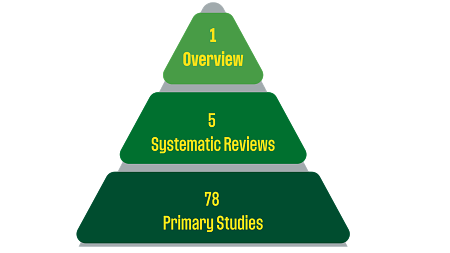
To understand what an overview of reviews is, you first need to know a little about systematic reviews. Systematic reviews synthesize results from multiple individual research studies looking at the same question, combining the study results to get a more holistic view of evidence. Then, overviews of reviews take it one step further and combine information from all systematic reviews on a topic. By bringing together evidence from multiple systematic reviews, an overview can provide a comprehensive summary of everything researchers know, where evidence is strongest, and where important questions remain unanswered.
For our overview of reviews on school-based suicide prevention interventions, we searched the literature and found more than 8000 unique citations related to suicide prevention. Two people on our team looked at the references to decide if each one was relevant and then did detailed reading and coding for each review. This process is obviously time-consuming, and we’re training new AI tools to speed things up while remaining accurate.
Ultimately, our overview includes results from five systematic reviews, and those five systematic reviews include results from 78 studies on school-based suicide prevention interventions. It’s more efficient for a busy educator to read one overview of reviews than five systematic reviews or 78 studies!
Read the overview: "Are school-based suicide prevention programs effective?"
Not all overviews of reviews are created equal.
High-quality overviews adhere to rigorous standards designed to make them trustworthy. For example, our team uses a framework called GRADE to assess certainty in the results we report. When we have uncertainty in results, we use words such as “probably” and “may” to communicate our uncertainty, or varying levels of confidence in the findings. If we have high certainty in the results, we describe effects with more confidence. For example, we might say that results indicated an intervention is beneficial, instead of saying it may be beneficial. Here are some examples from our suicide prevention overview:
- When we had moderate certainty in results, we indicated that effects were probable.
- “Two reviews found that school-based prevention interventions probably reduced suicidal ideation…”
- “Two reviews found that school-based prevention interventions probably reduced suicidal ideation…”
- When we had low certainty in results, we indicated that effects may be present.
- “One review with high school students found that school-based suicide prevention interventions may increase suicide awareness…”
- “One review with high school students found that school-based suicide prevention interventions may increase suicide awareness…”
- When we had very low certainty in results, we indicated an effect may be present but that the evidence was very uncertain.
- "Universal suicide prevention interventions may not differ in their effects... on suicidality with adolescents in school-based settings and with young adults in college/university settings; however, the evidence is very uncertain..."
What does this mean for policy and practice?
You might have noticed that none of the examples above say that school-based suicide prevention interventions definitively provide benefits. The results from the original individual studies were varied, with many showing benefits but some showing no benefits. And unfortunately, our overview also found that most systematic reviews on school-based suicide prevention relied on individual studies that had limitations in their methods, and the systematic reviews also had limitations in their methods. Therefore, we didn’t have high certainty in any of the results.
We communicated this uncertainty by making explicit that the evidence isn’t certain enough to warrant policy mandates for any particular brand of intervention.
With this in mind, educators should be suspicious of intervention vendors that claim proven superiority. Decision-makers should also consider their specific school contexts when choosing among intervention options, including student characteristics and cultural appropriateness of the interventions. They should also have a plan in place for handling referrals to additional services when needed, and they should monitor implementation fidelity, reach, acceptability, and student outcomes.
Ongoing HEDCO overviews
At the HEDCO Institute we are also conducting overviews of systematic reviews on additional topics, including school-based prevention of anxiety and depression. As we complete these overviews, the results are being added to our interactive dashboards, allowing decision-makers to filter the data to match their schools.
We also use our overviews to inform our own living systematic reviews and meta-analyses on mental health prevention programs delivered to students during school hours, which we share with educators and researchers via our dashboards, evidence hub, and other publications. Keep an eye on our dashboards and our evidence hub for updates and new findings from our overviews of systematic reviews.
In a field like education where thousands of studies can accumulate over time, overviews of reviews offer something valuable: a way to see all the best research at once, giving decision-makers the full picture.
Want more from the HEDCO Institute: Sign up for our emails!
HEDCO Institute article 33 - September 30, 2026