

Getting research into the hands of practitioners and policymakers does not happen by accident: it takes resources, a deliberate focus, and a supportive organizational environment, among many other things.
To help simplify the ins and outs of these processes, we asked professionals who specialize in knowledge mobilization to offer their insights and experiences. We’ll present their insights over the next year through an Ask HEDCO series: Knowledge Mobilization 101.
First, HEDCO Institute's Elizabeth Day and Kristen Elmore (Executive Director of the Bronfenbrenner Center for Translational Research) address an important question to launch the series: what exactly is knowledge mobilization, and why is it important?
What is knowledge mobilization?
In recent years, researchers have increasingly recognized the need to get research off the shelf and into the hands of practitioners, policymakers, and the public. But this process isn’t always simple or straightforward, as we have both seen firsthand across different roles we’ve held including teacher, social worker, policy staffer, parent, and researcher, to name a few. Different priorities, timelines, and ways of communicating make it continually difficult to bring evidence producers and users together. We both are involved in knowledge mobilization work to try to bridge these divides. So, what is “knowledge mobilization” and why does it matter?
At its core, knowledge mobilization is the process of intentionally connecting researchers, practitioners, and policymakers so that evidence can be more useful and responsive to the needs of those who will put it to use.
There are many terms that have the same basic meaning, such as evidence mobilization, knowledge translation, translational research, transdisciplinarity, research-to-action, and practice-to-research. These terms are used differently across professions and describe different pathways for bridging research and action. For example:
- “Translational research” offers a formalized “T0-T4” or “bench to bedside” pathway that flows from a scientific discovery to broader population impact
- “Practice-to-research” flows instead from practitioner needs to research activities, commonly involving program evaluation or implementation science for exploring program impact and underlying mechanisms
- "Knowledge mobilization" takes a more iterative approach: researchers, policymakers, and/or practitioners collaborate throughout the life cycle of a research project to meet research users’ needs
Importantly, knowledge mobilization strategies involve the creation, sharing, and use of research alongside other forms of knowledge. Studies on the use of research in education have shown that educators weigh different types of information from a wide range of sources throughout decision-making processes, such as colleagues’ experiences and knowledge, personal experiences, political or constituent pressures, administrative data, or advice from trusted leaders. Research evidence sits among these various other sources, so when it’s highly technical, irrelevant, or difficult to digest, it’s far less likely to be used.
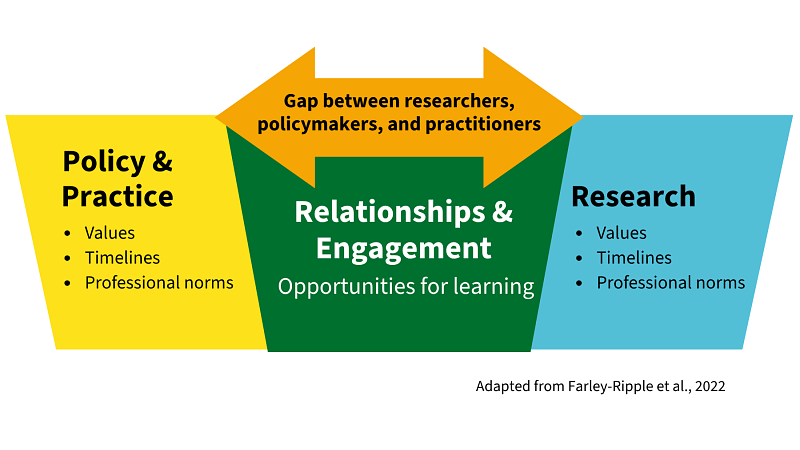
Central to successful knowledge mobilization across these approaches is a commitment to building relationships between researchers and educators, or as our team says, educational “interest-holders”, which includes anyone with a vested interest in education whose primary role is not research. Why? Because interest-holders themselves are experts on the context, values, timelines, and norms that shape decision-making. Through building trusted relationships, researchers and educational interest-holders can create spaces for shared learning which, in turn, can create more relevant, useful, and accessible evidence to inform decision-making and maximize benefits for youth.
Want more from the HEDCO Institute: Sign up for our emails!
HEDCO Institute article 31- September 2, 2026